

Speculative Technologies is a nonprofit research organization developing ambitious new materials and manufacturing technologies. It runs programs to derisk things that are too long-term, hard to justify, multidisciplinary, or public-goods oriented, filling a gap between academia and startups. In this issue of their newsletter, founder Ben Reinhardt shares their detailed response to the National Science Foundation’s RFI on its new Tech Labs program, a funding initiative to support full-time R&D teams tackling commercialization barriers for emerging technologies.

I read Wooded Shore, a great collection of short stories by Thomas McGuane. Full of unexpected plot twists and surprising writing - “I thought she was slapping herself in the face in the bar where we met, but it was how she eats peanuts.”

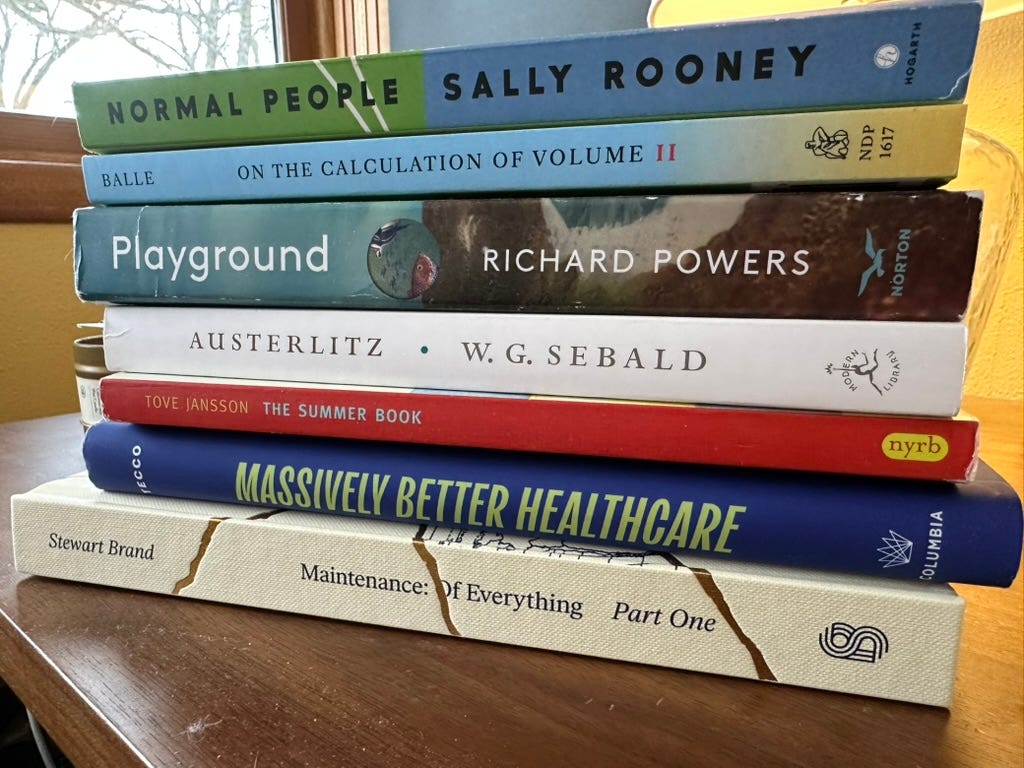
I am still reading Pacific Crucible. I had not appreciated that two months passed after Pearl Harbor before the US military launched its first offensive against Japanese positions. Hard to imagine such a timeline today. Meanwhile, my bedside book tower is piling up. I just received Halle Tecco’s new and acclaimed Massively Better Healthcare, which I’m looking forward to. Some fiction in the mix, too.
I recently learned about Holoclara, a clinical-stage company built from Caltech researcher Andrea Choe's insight that roundworms (helminths) evolved mechanisms to affect the human immune response so they could live inside us. She realized that meant there was probably something useful in their biology we could isolate and put to work. Holoclara is now developing novel therapeutics derived from those symbiotic organisms that modulate inflammation, metabolism, and tissue regeneration. With GLP-1s having emerged from gila monster saliva, who knows where roundworm spit will get us?
I built a small tool I’ve been wanting for a while: a digital version of those year-at-a-glance calendars that show all 12 months in one view. It started because managing multiple kids’ school breaks plus my own work and travel schedule was such a hassle. It’s called YearMap. Click and drag to mark date ranges, color-code by category, add notes, and export to your regular calendar. Free, runs entirely in your browser, no account required…If that sounds useful, I’d love your feedback. Just reply and I’ll send you the link.
My friend Laura Strong let me know you can order a free Lp(A) test in the mail from the Family Heart Foundation. Just got mine and am sending it away. I’ve been wondering for a while about Lp(A) - a type of LDL cholesterol that’s an inherited risk factor for heart disease - but my primary care doctor is either bored or befuddled by preventive medicine! So I've recently been on a bit of a solo march to get ahead of my heart health.
GitLab founder Sid Sijbrandij was diagnosed with a rare bone cancer in 2022, exhausted every standard treatment, and watched it come back. So he assembled a team and went after it with the full force of the latest genomics and experimental therapies from around the world, and put his cancer into remission. Elliot Hershberg's inspiring profile is a stunning look at what coordinated, first-principles cancer care can look like and accomplish.

Daniel Moerman spent decades compiling Native American Ethnobotany, a 900-page reference cataloging how 306 tribes used over 42,000 plants for nearly 67,000 medical applications.1 After Moerman died earlier this year, developer Adam Fleury converted the entire work into a searchable database. You can explore by ailment, plant, or tribe. Want to know what the Cherokee used for headaches, or which remedies five or more tribes independently converged on? It's a remarkable collection of indigenous knowledge, now far more accessible than it's ever been thanks to Adam’s generous side project.
In addition to his renowned work on ethnobotany, Moerman was an early, creative and prolific researcher into the placebo phenomenon. Reflecting on his career has me thinking someone (maybe me?) should be writing profiles of accomplished medical anthropologists and their groundbreaking contributions. They’re relevant and valuable today and disappearing from view…What do I do with these kinds of interests? Would you read a series profiling pioneering medical anthropologists? Hit reply and tell me.
This was a delightfully high-signal roundup, the kind that makes the internet feel like it’s still good for something. A few threads really clicked for me:
1. The Holoclara / “roundworm biology → therapeutics” bit is exactly the kind of translational humility I love: evolution has been running randomized experiments for millions of years, and “parasite-host détente” is basically immunology’s weirdest R&D lab. Your gila monster → GLP-1 analogy lands. 
2. YearMap is such a practical “small tool, big relief” idea. Anything that reduces cognitive load around calendars (especially with kids + travel) is a real health intervention in disguise. I’m very pro “analog clarity, digital convenience.” 
3. The Lp(a) mail-in test callout is also timely, not because everyone needs to become a self-directed preventive cardiologist, but because Lp(a) is one of those inherited risks that’s easy to miss until it isn’t. Your line about primary care being bored/befuddled is… unfortunately relatable. 
4. And the Moerman ethnobotany database mention is a perfect reminder that “modern” medicine is often catching up to patterned human observation, and that making knowledge searchable and usable is its own form of scientific contribution. 
There’s a real hunger right now for people who can bridge biology + meaning + culture without sliding into either cynicism or woo.
You do a nice job on your newsletter. Pls send YearPlan.
Thanks
Ron Pulvermacher